Firstly if you are reading this congrats! I don't know if any real people still read articles about arbitrary topics like this anymore in this AI hellscape we live in today but I digress. Secondly this is written by a Saffa who lives abroad but refuses to let go of the lingo. If you are not South African keep Google on standby. You are probably reading this article because someone told you that you need an ERP or you already have one and are reading this because I pushed some buttons. My TLDR is that if you have one you can keep it and extend its functionality. If you don't have one you probably don't need one. It is often an expensive and complicated solution that still often fails to address a lot of the reasons you likely want an ERP in the first place.
The ERP advice usually arrives around the twentieth employee, or the second warehouse, or the day a big retailer asks for its purchase orders over EDI. Maybe it comes from your auditor. Maybe it's a consultant. Maybe it's your ops manager, who just spent a Saturday counting stock because the sales report they generated on excel doesn't line up with the numbers they have on Sage. Your purchase orders live in a spreadsheet that only Thabo understands, and your accountant keeps asking where last month's cost of goods came from. One system, one database, one version of the truth? After a year of five tools that don't talk to each other, that sounds like a dream.
But hang on a second. I think "buy an ERP" is actually two decisions wearing one trench coat, and most businesses only need to make one of them. There are a few exceptions, and I'll touch on them a little later in this article (for those who are patient to read through my ramblings). The pain that starts the ERP conversation is almost always an a direct result of an operations pain point. And you don't fix an operations pain by ripping out the accounting platform that your bookkeeper, your finance team, and your auditors already know and trust. You could but my position is that in most cases you shouldn't or at least don't have to anymore. There are platforms that are very good at addressing operational concerns without being an ERP. Miridia is not the only one, but I think it is a good option. 😏. Your accounting software does what it needs to do well and is typically does that cost effectively. You don't need to overcomplicate the finance core of the business.
Okay, so what's actually inside an ERP?
Take the brochure away and an ERP is two systems sold on one contract. The first is the money side: the general ledger, debtors and creditors, bank recons, VAT, and the reporting that keeps you square with SARS. The second is the operational concerns which I like to call "other stuff": inventory, purchasing, sales orders, bills of materials, work orders, production planning, and getting boxes out of the door and onto a bakkie. Same database, same vendor, same invoice. Different problems, though, and different people in your business care about each one. Here's the bit that matters most: the two sides change at completely different speeds.
The money side should change slowly. That's the whole point of it. Accounting standards move over years, your chart of accounts should be boring, and a ledger that surprises you is a ledger with a problem. The stuff side changes every time you try something new. A second site in Cape Town. A new channel on Takealot. A product you now assemble from six components. A retailer that wants EDI. A supplier who decides to ship in cases of 24 instead of 12, without telling anyone. Put both halves on one contract and the slow half sets the pace for the fast half. So the part of your business that changes every quarter ends up waiting on a project plan built for the part that changes every decade. Eish.
And here's why that split is a big deal right now. Over the last ten years, the money side got sorted out for a huge number of businesses. Xero, Sage, QuickBooks, and Zoho Books give a small or mid-sized business a compliant ledger, VAT returns, bank feeds, and an accountant who already knows the software, all on a monthly subscription. Nobody had to run a year-long implementation project to get there. For loads of businesses, that half of the ERP is done. It's probably open in a browser tab right next to this one.
Where your accounting platform runs out of road
Let me be fair to the accounting platforms, because they're genuinely good at their job. Their job is recording what you did with money. They're not built to run what you do with stock. Most of them can keep a simple item list with a quantity, and some can track stock in more than one location. But they won't run a production floor or a multi-site operation, and to be fair, their vendors never said they would. That gap is exactly what sends people shopping for an ERP. So let's look at what's actually in it.
First up: the bill of materials. If you manufacture, or you assemble or kit your own products, you need to write down what goes into each finished thing. Which components, how much of each, how much you lose as scrap, and the labour and overhead on top. That recipe changes over time, so it needs versions with dates. A product you made in March should be costed with the March recipe and the March component prices, not whatever things cost today. Then you need work orders that use that recipe to take components out of stock and put finished goods in, valued at what they really cost to make. Your accounting package sees you buy the flour, and it sees you sell the biscuit. Everything that happens in the bakery in between? It has no idea.
Second: planning. Working out what to make and what to buy next month means looking at a demand forecast, the stock you have at each location, the purchase orders already out there, and the recipes that turn "we'll sell 2,000 tubs" into "we need this much cream, this many lids, and this many labels". That's MRP, material requirements planning, and it's the main reason manufacturers believe an ERP is the only way. Third: everything around the order itself. Stock reserved across channels and sites, transfers between Joburg and Durban, goods received against purchase orders, supplier certificates, and deliveries to customers. None of that is accounting. All of it ends up in the accounts eventually.
The other option: build on the books you already have
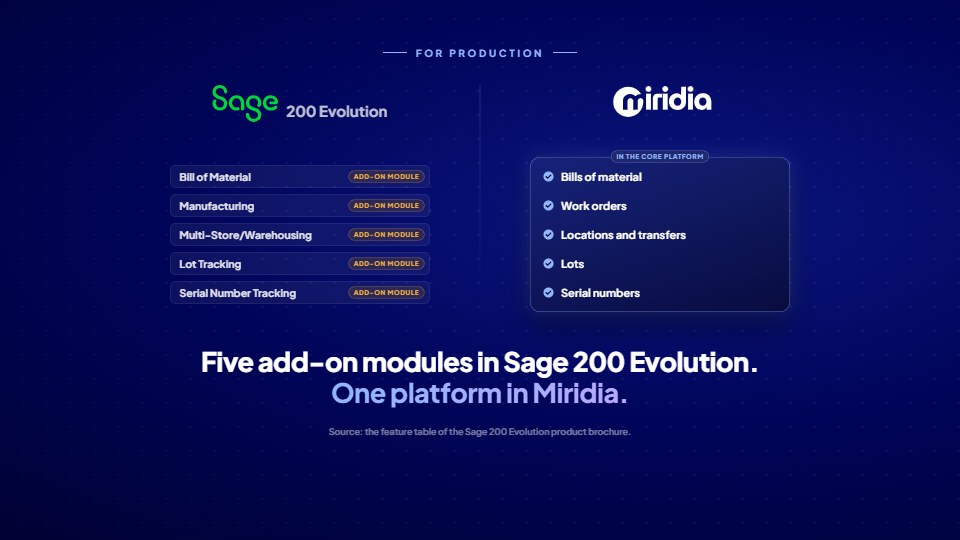
So here's the alternative. Keep your accounting platform for the money side, and put an operations platform next to it for the stuff side. Quick heads-up before I carry on: this is exactly what Miridia does, so we have skin in this game. Read this bit with that in mind. In Miridia, a bill of materials has versions with effective dates, a scrap factor on each component, and cost lines for labour and overhead. A work order takes a snapshot of that recipe, moves the components out of stock for real, and books the finished goods into inventory at their actual cost. Cost roll-ups use the component prices from the date that matters, and the MRP reports tell you what to buy. Add Miridia Planner and the forecast feeds your reorder points and MRP directly. No more forecast spreadsheet that somebody promises to update now-now.
The link to your books is where this whole idea either works or falls flat, so poke at it hard. Miridia connects to Xero, QuickBooks, Sage Cloud, and Zoho Books out of the box, and to Sage Evolution and Odoo through our consulting team. It syncs your products along with their recipe costs, syncs your customers, creates the invoices, keeps the ledger in step, and maps each cost line on a recipe to the right general ledger account. So the operational work happens in a system built for operations, and your accounting platform gets the numbers in the shape your accountant expects. Finance keeps its tools, its month-end routine, and its auditors. Nobody has to learn a new ledger.
You'll feel the difference in two places. The first is how fast you get going. Nothing on the finance side has to move, so you can go live in weeks, one module at a time, instead of one terrifying cutover weekend that moves the ledger and the warehouse at the same time. If you've lived through one of those weekends, you know. The second is how easy it is to change things later. Because the operations platform sits on its own, you can add a site, a sales channel, or a production line without first asking whether it's going to wreck month-end.
When you really do need an ERP
I'd be lying if I said this works for everyone, and I'd much rather tell you now than three months into a sales chat. Ignore everything above if one of these is you.
- You report in lots of countries, with a stack of legal entities and a group consolidation every month. You can stretch a cloud accounting platform across a few entities, but at real scale the consolidation, the intercompany eliminations, and the local tax rules are the actual problem, and an enterprise suite handles them in one place.
- You already run SAP, Oracle, or Dynamics 365, and it works. Don't rip out a working ERP. Ask what it's bad at instead. Usually that's the connections to your online stores, your couriers, and your planning tools, and an operations platform can handle that layer around it without replacing anything.
- Your finance team wants one vendor, one database, and one number to phone, and it's happy to pay for that. Fair enough. That's a real preference, especially with a small finance team and simple operations. Two systems do mean two relationships.
- Your accounting platform is the actual problem. If your books are a mess, fix the books first. Miridia isn't a general ledger, and no operations platform will rescue a set of books your accountant has stopped trusting.
If none of those sound like you, then buying an ERP mostly means swapping out an accounting platform that works, just to get stock and production control. When you say it out loud like that, it's a pricey way to solve a problem that has a much more direct fix.
Full disclosure
Miridia is a supply chain automation platform, and we sell the approach this article recommends. So yes, I'm biased. We compete with the operations half of an ERP. We don't compete with the money half: Miridia isn't a general ledger, and it's built to work with the accounting platform you already run. Take the argument with a pinch of salt, and test it with the six questions above. They apply to us as much as to anyone else.
If you're stuck between an ERP and your current accounting platform, send us the requirement list you'd give an ERP vendor. We'll mark what Miridia does, what it doesn't, and what would need our consulting team, and we won't pad the first column. Let's connect.